For seventy years, archaeologists in Podlasie have been turning fragments recovered from the ground into a deeper understanding of the region's past.
Archaeology rarely gives us the past in complete form. Instead, it offers fragments: a vessel, a piece of jewellery, a burial, a building, a trade object or a military artefact. Their meaning emerges gradually, as researchers connect individual discoveries with the places and communities from which they came.
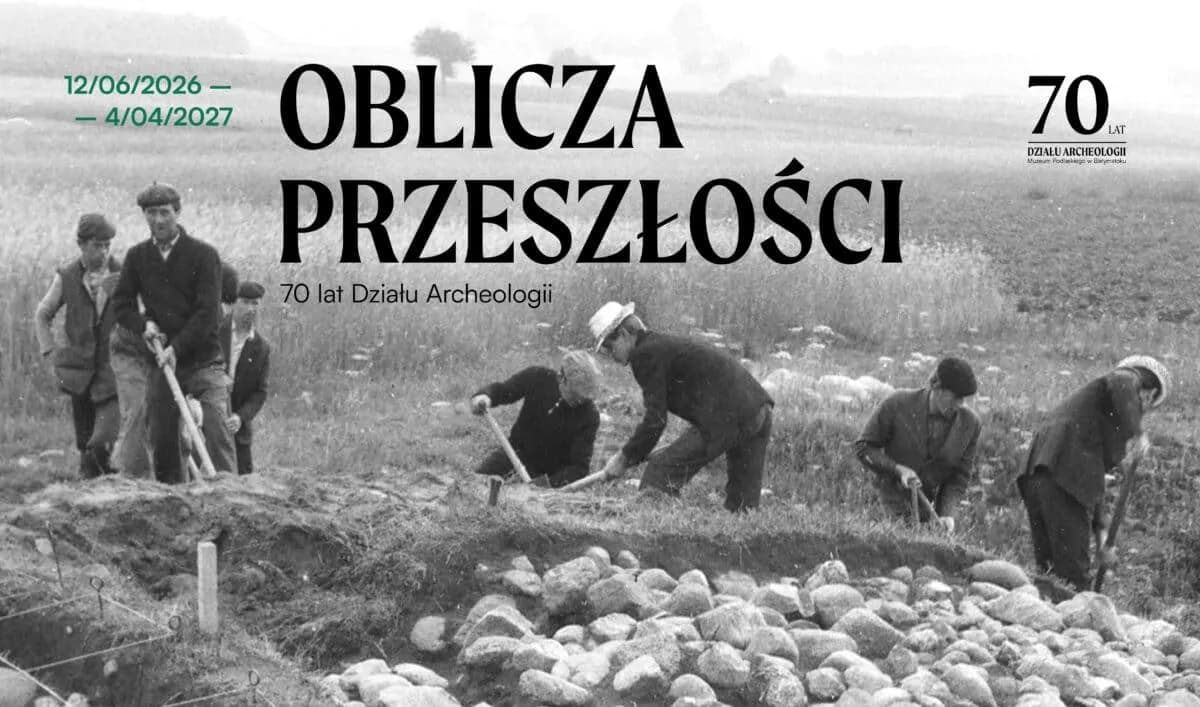
That process is at the centre of the 70th-anniversary exhibition of the Archaeology Department of the Podlasie Museum, currently on display at Białystok City Hall.
The exhibition brings together the department's history through seven decades of research, hundreds of expeditions and thousands of archaeological objects. Rather than presenting this work as a simple catalogue of discoveries, it follows how archaeological research in Podlasie has developed through changing conditions, successive generations of researchers and evolving scientific interests.
The result is a journey through the ancient history of Podlasie and northeastern Poland, extending from the Stone Age to the modern era.
Reading a region through the places people left behind
One of the exhibition's strengths is its emphasis on landscape.
The archaeological story leads through river valleys, ancient settlements, strongholds and historic towns. Burial mounds and mysterious residences add further points of investigation, creating a picture of a region shaped by generations of human activity.
These places provide the context in which individual objects become meaningful.
A clay vessel is no longer simply a piece of pottery when considered alongside the settlement where it was found. Jewellery can provide evidence of craftsmanship and status, while remains from cemeteries offer another perspective on how communities treated their dead.
The exhibition therefore encourages visitors to think about archaeology geographically as well as chronologically. The history of northeastern Poland is presented as something embedded in its landscape, with traces of earlier communities continuing to shape what researchers can discover today.
Everyday objects reveal connections beyond Podlasie
Some of the objects presented are striking precisely because they were part of ordinary life.
Clay vessels and decorated tiles reveal aspects of domestic environments and craftsmanship, while finely made jewellery represents another side of material culture. Together, these objects help move the archaeological story beyond major monuments and famous historical events.
Other finds point towards much wider connections.
Textile seals and early medieval amphorae provide evidence of trade routes and contacts extending beyond the immediate region. Their presence demonstrates that the communities living in northeastern Poland were connected to broader networks through which goods and cultural influences travelled.
This gives the exhibition a particularly interesting dimension. Podlasie emerges not as an isolated corner of Europe, but as a region where different routes and influences intersect.
Military history also forms part of the picture. Finds from ancient cemeteries, including urns and a stone tombstone, add further evidence to the archaeological record and broaden the exhibition's view of the people who lived here.
Seven decades, and generations of researchers
The anniversary is ultimately about more than the objects themselves.
The exhibition tells the history of an archaeological department whose work has been carried out by successive generations of researchers. Their individual projects and areas of interest have accumulated into a much broader understanding of the region.
That cumulative nature is important. Archaeology depends not only on discovering objects but also on recording, studying, conserving and interpreting them. Each generation builds on what came before, while new research questions can change how existing evidence is understood.
The exhibition also makes space for the work that allows archaeological heritage to remain accessible. Dominika Wybult supports the project through digitisation, while Jerzy Ostapczuk leads the conservation work. These less visible processes are an essential part of what happens between an archaeological discovery and its presentation to the public.
The exhibitions curatorial team brings together Halina Karwowska, Ireneusz Kryński, Hubert Lepionka, Kornelia Piasecka, Aleksander Piasecki, Katarzyna Rusin, Irena Taranta, Adam Wawrusiewicz and Krzysztof Żurek.
For visitors, the anniversary provides an opportunity to see Podlasie through the accumulated evidence of seventy years of archaeological work. The objects tell stories of everyday life, craftsmanship, trade, settlement and burial, while the places represented by those finds reveal how deeply human history is embedded in the landscape.
The exhibition's broader message is perhaps the simplest: understanding a region takes time. Across seven decades, thousands of fragments have gradually become part of a larger picture, allowing the history of northeastern Poland to be read not only through written records, but through the physical traces left behind by the people who lived here.
Visitor Information
Exhibition: 70th-anniversary exhibition of the Archaeology Department of the Podlasie Museum
Venue: Białystok City Hall, Kościuszki Square 10, Białystok
Opening date: 12 June 2026
On display until: 4 April 2027
Curators: Halina Karwowska, Ireneusz Kryński, Hubert Lepionka, Kornelia Piasecka, Aleksander Piasecki, Katarzyna Rusin, Irena Taranta, Adam Wawrusiewicz and Krzysztof Żurek.